
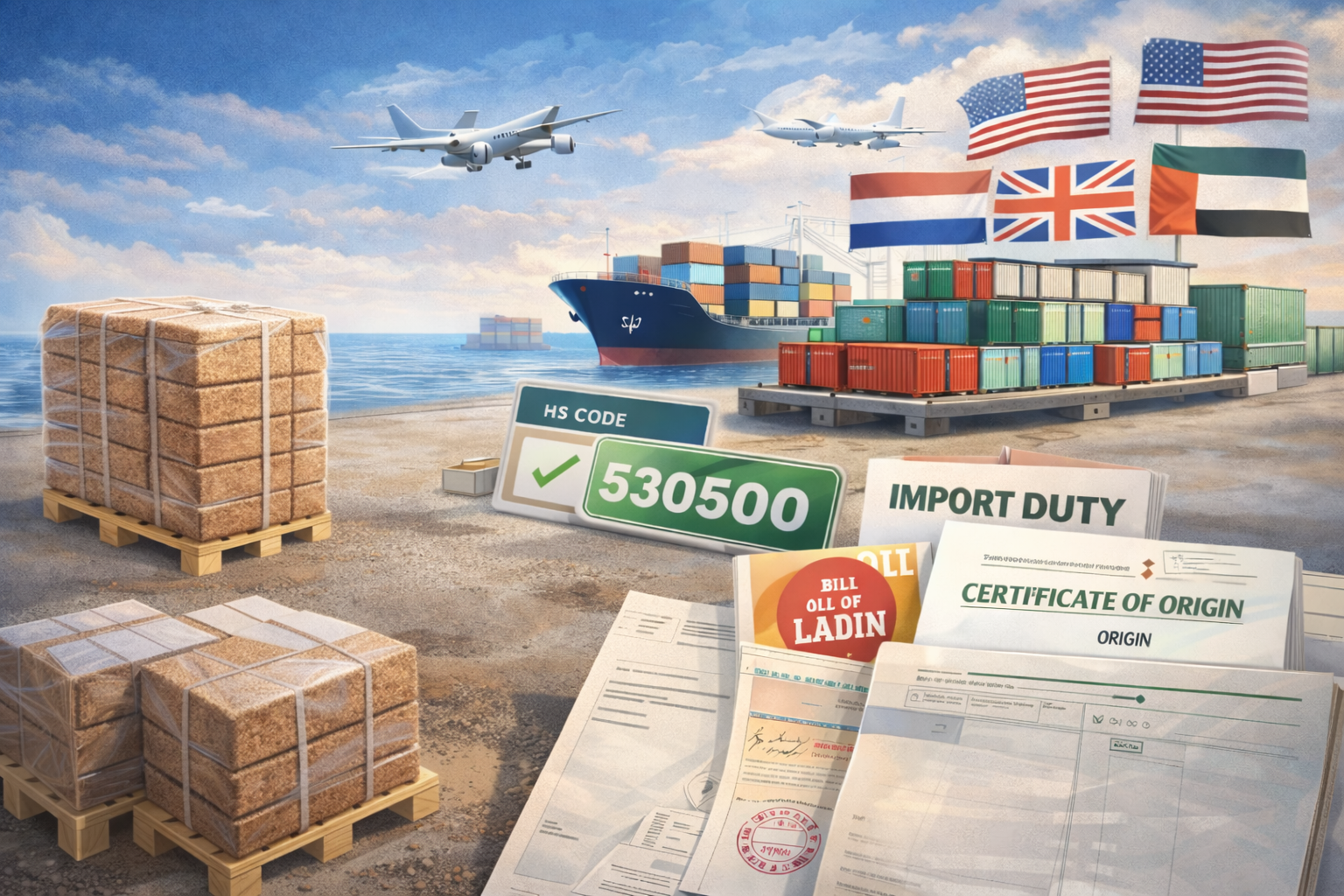
Cocopeat HS Code, Import Duties & Packing – The Complete 2026 Importer Checklist (Worldwide)
Introduction: Why Cocopeat Imports Fail (and How to Avoid It)
Cocopeat imports look deceptively simple. The product is natural, widely used, and globally traded. Yet, a significant percentage of cocopeat shipments face delays, inspections, reclassification, or unexpected costs — not because of product quality, but because of classification, documentation, and packing errors.
Importers often focus on:
- Price per block
- Compression ratio
- Expansion volume
But customs authorities focus on:
- HS code accuracy
- Declared product description
- Packing format
- Consistency across documents
- Compliance with local import rules
This guide is designed as a single, authoritative reference for:
- Cocopeat HS codes (global + country-wise)
- Import duties and taxes
- Packing formats approved for export
- Documentation requirements
- Major cocopeat importing countries
- Common mistakes importers make
- Practical landed-cost planning
If you are an importer, distributor, hydroponic farm operator, or bulk buyer, this guide is meant to be saved, bookmarked, and reused.
What Is Cocopeat? (Customs & Trade Definition)
Cocopeat, also referred to as coir pith, is a by-product obtained during coconut husk processing. From a customs and regulatory standpoint, cocopeat is:
- A vegetable-origin product
- Classified under coir / coconut fibre derivatives
- Typically untreated, inert, and organic
- Used as a growing medium or soil conditioner
- Distinct from soil, compost, or fertilizer
This distinction is critical. Declaring cocopeat incorrectly as soil or compost is one of the fastest ways to trigger inspection or rejection.
Customs authorities assess:
- Product description
- Processing level
- Presence (or absence) of additives
- Intended agricultural use
Buyers evaluating cocopeat for agriculture or hydroponics often compare it with traditional growing media, which is explained in detail in our guide on cocopeat vs soil for plant growth.
Cocopeat HS Code – Global Standard Classification
Internationally Accepted HS Code for Cocopeat
HS Code: 530500
Description:
Coconut, abaca (Manila hemp), ramie, and other vegetable textile fibres, raw or processed
This HS code is accepted in most importing countries worldwide for:
- Cocopeat blocks
- Cocopeat briquettes
- Cocopeat grow bags / slabs
- Loose coir pith (less common)
Country-Level HS Code Variations
While the base HS code remains the same, countries may extend it to 8 or 10 digits.
| Country / Region | HS Code Used |
|---|---|
| United Arab Emirates (UAE) | 53050000 |
| Saudi Arabia | 53050000 |
| European Union | 53050000 |
| United Kingdom | 5305000000 |
| India (Export) | 53050090 |
| United States (HTS) | 5305000000 |
| Canada | 53050000 |
| Australia | 53050000 |
Important:
If cocopeat is buffered, pre-mixed with nutrients, or chemically treated, customs authorities may:
- Request additional documentation
- Reclassify the product
- Apply different duties
Cocopeat Import Duties & Taxes (By Region)
Middle East & GCC
United Arab Emirates (UAE)
- Import Duty: 0%
- VAT: 5%
- Phytosanitary Certificate: Usually not required for untreated cocopeat
- Clearance: Fast and predictable
UAE is one of the largest cocopeat import hubs globally, driven by hydroponics, landscaping, and greenhouse farming.
Saudi Arabia
- Import Duty: 0–5%
- VAT: 15%
- Used widely in agriculture and landscaping projects
Qatar, Oman, Kuwait, Bahrain
- Import Duty: 0%
- Minimal compliance for untreated cocopeat
European Union
EU imports are stable, high-volume, and compliance-driven.
- Import Duty: 0–4%
- VAT: Country-specific (18–25%)
- Documentation checks: Moderate to strict
Common EU importers include:
- Netherlands
- Germany
- France
- Spain
- Italy
- Poland
The Netherlands acts as a major entry and redistribution hub for cocopeat across Europe.
United Kingdom
- Import Duty: Mostly 0%
- VAT: 20%
- Clear documentation and labeling are critical post-Brexit
Americas
United States
- Import Duty: 0%
- HS Code: 5305000000
- Used in hydroponics, retail gardening, and greenhouse farming
- Strict labeling expectations
Canada
- Import Duty: 0%
- Documentation consistency is essential
Latin America
Countries like Mexico and Chile import cocopeat primarily for commercial farming, with duties ranging from 0–6%.
Cocopeat Packing Formats for Export (Customs-Approved)
1. Cocopeat Blocks (Most Common Export Format)
- Weight: 4.5 kg / 5 kg
- Compression: High
- Expansion Ratio: 1:5 to 1:8
- Container Load: ~18–20 MT (40ft HC)
- Most commercial buyers prefer compressed cocopeat blocks for export due to freight efficiency and consistency.
Advantages:
- Lowest freight cost per unit
- Easy handling
- Preferred by distributors and farms
2. Cocopeat Briquettes
- Weight: 650 gm
- Retail and hobby markets
- Often private-labeled
Advantages:
- Consumer-friendly
- Suitable for e-commerce and retail
Consideration:
- Higher packaging cost per ton
3. Cocopeat Grow Bags / Slabs
- Pre-shaped slabs
- Often buffered
- Used directly in hydroponic systems
Buyers sourcing cocopeat grow bags should ensure clear labelling and consistent specifications.
Advantages:
- High value
- Ready-to-use format
Customs Note:
Requires clear labeling and consistent product description.
4. Loose Cocopeat (Bales)
- Lower compression
- Higher freight volume
- Higher inspection risk
Not recommended unless specifically requested by the buyer.
Mandatory Cocopeat Export & Import Documentation
Commercial Documents
- Commercial Invoice
- Packing List
- Bill of Lading / Airway Bill
- HS Code declaration
Compliance Documents
- Certificate of Origin
- Phytosanitary Certificate (if required)
- Product Specification Sheet (EC, pH, moisture)
- MSDS (on request)
Importers sourcing from India should also understand the complete shipment flow, supplier checks, and documentation process, which is covered in detail in our guide on how to import cocopeat from India.
Packing & Labeling Requirements
- Net weight & gross weight
- Country of origin
- Batch / lot number
- Product usage declaration
Mismatch across documents is one of the most common reasons for inspection.
Major Cocopeat Importing Countries (Global Overview)
Middle East & Asia (High Volume)
| Country | Import Duty | Notes |
|---|---|---|
| UAE | 0% | Regional redistribution hub |
| Saudi Arabia | 0–5% | Landscaping & farming |
| Qatar | 0% | Hydroponics |
| Oman | 0% | Greenhouse expansion |
| Singapore | 0% | Strict compliance |
| Malaysia | 0–5% | Plantation use |
| Thailand | 0–5% | Re-export market |
Europe (Compliance-Driven)
| Country | Import Duty | VAT |
|---|---|---|
| Netherlands | 0–4% | EU entry hub |
| Germany | 0–4% | High compliance |
| France | 0–4% | Hydroponics |
| Spain | 0–4% | Greenhouse farming |
| Italy | 0–4% | Horticulture |
| Poland | 0–4% | Growing demand |
| UK | 0% | VAT 20% |
Americas
| Country | Import Duty | Notes |
|---|---|---|
| USA | 0% | Hydroponics & retail |
| Canada | 0% | Labeling focus |
| Mexico | 0–5% | Commercial farms |
| Chile | 0–6% | Greenhouses |
Africa (Emerging Markets)
| Country | Import Duty | Notes |
|---|---|---|
| South Africa | 0–10% | Commercial farming |
| Kenya | 0–10% | Floriculture |
| Morocco | 0–5% | EU-aligned |
| Egypt | 0–10% | Growing imports |
Common Cocopeat Import Mistakes
- Using an incorrect HS code
- Declaring cocopeat as soil or compost
- Missing EC or pH values
- Inconsistent packing descriptions
- Ignoring local VAT or port charges
These mistakes often cost more than the product itself.
Cocopeat Landed Cost Calculation (Practical View)
For a 40ft High Cube container of cocopeat blocks:
- Product cost (FOB): ~60–70%
- Ocean freight
- Insurance
- Import duty
- VAT / GST
- Port handling & clearance
Key takeaway:
Never evaluate a supplier based on FOB price alone.
Final Cocopeat Importer Checklist
✔ Confirm HS code before shipment
✔ Choose correct packing format
✔ Verify EC, pH, and moisture
✔ Align all documents
✔ Calculate landed cost, not just product cost
Frequently Asked Questions (FAQ)
What is the correct HS code for cocopeat?
The most widely accepted HS code for cocopeat is 530500.
Is cocopeat import duty-free?
In many countries such as UAE, UK, and USA, import duty is 0%.
Is phytosanitary certificate required?
Usually not for untreated cocopeat, but rules vary by country.
Which packing format is best for export?
Compressed cocopeat blocks are the most cost-efficient and widely accepted.
Conclusion: Why This Guide Matters
Cocopeat is a global commodity, but successful imports depend on precision, not assumptions. Importers who understand HS codes, duties, packing formats, and documentation face:
- Fewer delays
- Lower hidden costs
- Predictable supply chains
Use this guide as a reference point before every shipment, regardless of destination.
Ready to Source Cocopeat with Confidence?
If you are planning to import cocopeat for commercial farming, hydroponics, or distribution, working with an experienced exporter reduces risk and delays.
At Coco-hub, we support international buyers with:
- Export-ready cocopeat blocks and grow bags
- Clear HS code and documentation alignment
- Country-specific packing guidance
🌐 Website: https://coco-hub.com
📩 Email: [email protected]
📞 Phone / WhatsApp: +91-9092933399 / 9597829123
Reach out for specifications, packing details, or a destination-aligned quotation.

Add comment