
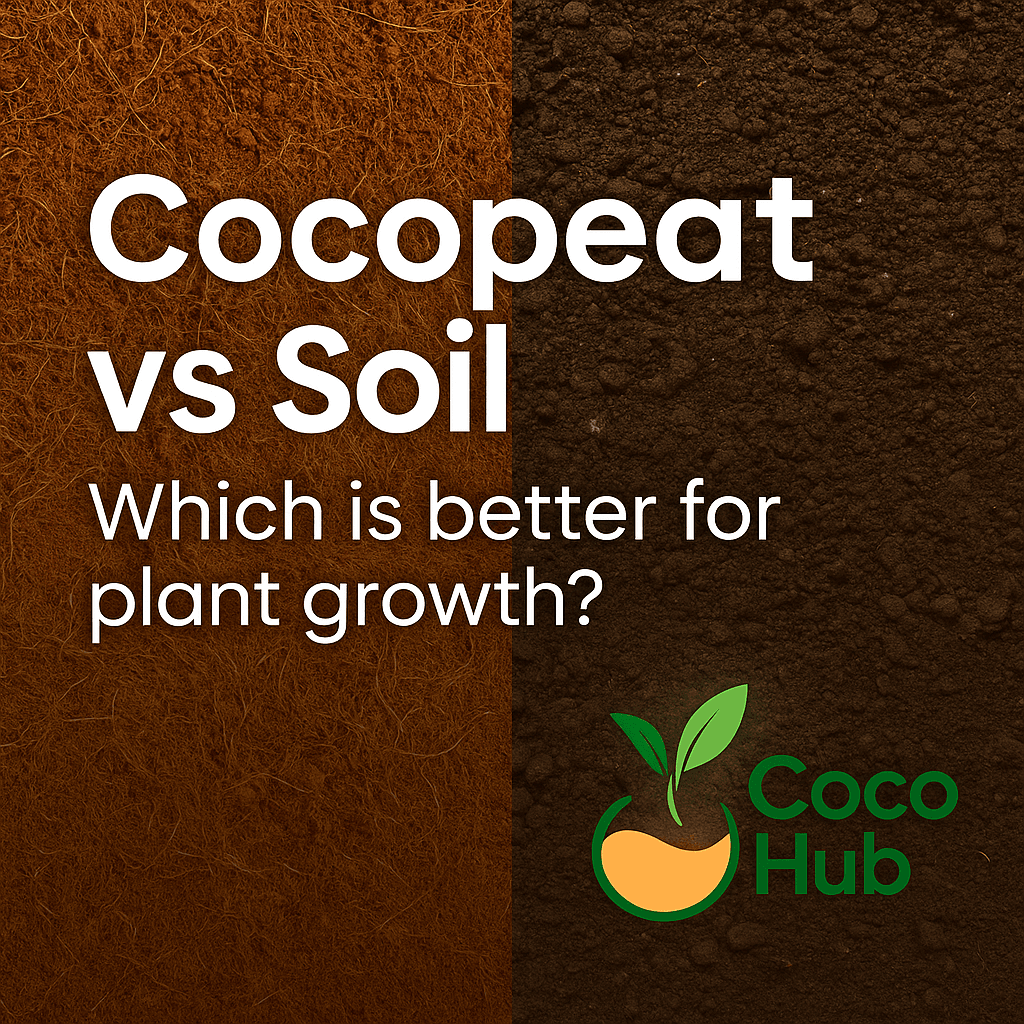
🥥 Cocopeat vs Soil Introduction: Why This Topic Matters in 2025
The shift from traditional soil to modern substrates like cocopeat is one of the most important transformations in global agriculture. Urban gardening, hydroponics, climate-smart farming, and commercial nurseries have driven massive demand for cleaner, lighter, sustainable alternatives.
As a leading exporter of high-quality cocopeat products, Coco-Hub receives hundreds of inquiries annually from buyers asking one question:
“Is cocopeat better than soil?”
Choosing the right growing medium can make or break your plant’s success. For years, growers debated cocopeat vs soil — which one provides better growth, aeration, and sustainability?
In this guide by Coco-Hub answers that question with scientific clarity, practical insights, expert references, and real-world export considerations.
🌿 What Exactly Is Cocopeat?
Cocopeat, also known as:
- Coir pith
- Coir dust
- Coco coir
- Coconut peat
…is a natural byproduct of coconut husks.
It is lightweight, sustainable, pest-free, and excellent for plant health — making it one of the fastest-growing growing mediums worldwide.
🔹 Key Benefits
- Retains 8–10× water
- Improves aeration
- Neutral pH (5.5–6.8)
- No pests, weeds, or diseases
- Easy to compress and ship
- 100% biodegradable
Expert Quote:
“Cocopeat is one of the most sustainable, versatile substrates available today. Its aeration and water-holding properties significantly outperform soil.”
— Dr. Meenakshi Iyer, Horticulture Researcher (UAS Bangalore)
For more details on sourcing and export standards, check out our complete guide:
👉 How to Import Coco Peat from India – A Complete Guide for International Buyers
🌱 What Is Soil?
Soil is the earth’s natural growing base — a mixture of minerals, organic matter, and microbes. While it’s nutrient-rich and abundant, it’s less consistent than cocopeat and prone to compaction, pests, and poor drainage.
Advantages:
- Naturally rich in organic nutrients
- Easily available and cost-effective
- Encourages microbial activity for plant health
However, soil can retain water unevenly and restrict root growth over time.nutrients, and a living ecosystem that supports plant roots and microbial life.
✅ Advantages of Soil:
- Naturally rich in minerals and organic nutrients.
- Easy availability in most regions.
- Contains beneficial microbes that help with nutrient cycling.
⚠️ Limitations:
- Compaction: Over time, soil becomes dense, limiting root oxygen.
- Pest & weed risk: May contain diseases or unwanted seeds.
- Weight: Heavier, making it difficult to handle or transport.
- Quality variation: Soil fertility differs by region and may degrade over time.
FAO Report (2022):
“33% of the world’s soil is moderately to highly degraded due to erosion, chemical contamination, and nutrient depletion.”
⚖️ Cocopeat vs Soil: The Ultimate 10-Point Comparison (2025)
This is the most comprehensive breakdown available for growers and international buyers.
1. Water Retention
⭐ Cocopeat
- Holds up to 900% water
- Releases moisture slowly
- Great for reducing irrigation cycles
⭐ Soil
- Low water retention (20–30%)
- Dries faster
- Requires frequent watering
World Bank Agriculture Review (2023):
“Cocopeat-based systems reduce irrigation frequency by 45–55% in tropical climates.”
2. Aeration & Root Oxygenation
Cocopeat remains loose and airy — even after years.
Soil becomes compacted, suffocating roots.
Journal of Plant Science (2024):
Cocopeat maintains air-filled porosity above 25%, compared to 8–12% in compact soil.
3. pH Levels
Cocopeat: Neutral (5.5–6.8).
Soil: Highly variable (4.5–9.0+).
Plants prefer stable pH — and cocopeat delivers consistency.
5. Pests, Weeds & Contamination
Cocopeat is naturally sterile, meaning:
- No nematodes
- No weeds
- No pathogens
Soil often carries pests, requiring sterilization or chemical treatments.
6. Sustainability & Environmental Impact
⭐ Cocopeat
- 100% renewable
- Made from coconut waste
- Reduced landfill impact
- Lower carbon footprint
⭐ Soil
- Mining destroys ecosystems
- Leads to erosion
- Loses nutrients over time
WWF (2023):
Soil erosion contributes to $500 billion in annual global losses.
7. Reusability
Cocopeat can be reused 2–3 cycles after washing.
Soil declines after each crop cycle.
8. Portability & Export Suitability
Cocopeat wins effortlessly:
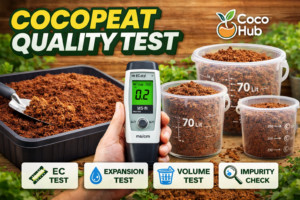
- 5kg compressed blocks = 75L expanded
- Lightweight
- Easy to palletize
- Perfect for exporters
Soil is heavy, unsterile, and unsuitable for import/export.
9. Growing Performance
Grower studies show:
- Faster germination
- Better root mass
- Higher flower/yield production
- Stronger disease resistance
Cocopeat provides optimal moisture + oxygen balance.
10. Cost Efficiency
One 5kg block replaces 3–4 soil bags, reducing:
- Shipping cost
- Transportation effort
- Storage space
For exporters: cocopeat is significantly more profitable.
🌿 Scientific Insights
🧪 Root Respiration
Healthy roots require oxygen. Cocopeat’s structure prevents suffocation.
🦠 Beneficial Microbes
Cocopeat naturally supports beneficial microbes like Trichoderma.
💧 Water Efficiency
Cocopeat reduces irrigation needs dramatically — ideal for arid regions (UAE, Qatar, Oman).
🌎 Sustainability Analysis
Cocopeat is central to circular agriculture:
- Waste → useful product
- Reduces carbon footprint
- Supports regenerative farming
Soil extraction, meanwhile, disrupts natural ecosystems.
🧑🌾 Best Cocopeat Applications
📌 Seed Germination
Use coins, discs, or 100% fine cocopeat.
📌 Potting Mixes
60% cocopeat + 40% compost.
📌 Hydroponics
70% cocopeat + 30% perlite.
📌 Open Field
50% soil + 50% cocopeat.
🧳 Export Buyer’s Guide
(Perfect for Netherlands, China, UAE, US, EU buyers)
Why import cocopeat?
- Consistent quality
- Controlled EC levels
- Certifications available
- Long shelf life
Why order from Coco-Hub?
- Near Tuticorin Port
- Export-ready packaging
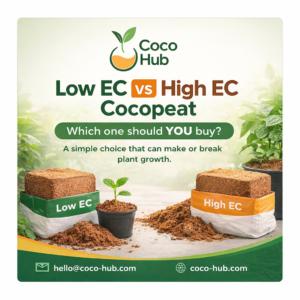
- Low EC / High EC options
- Private labeling
- SGS & lab testing support
🔗 Internal Links
👉 Cocopeat 5kg Low EC: https://coco-hub.com/cocopeat-5kg-low-ec/
👉 Cocopeat 5kg High EC: https://coco-hub.com/cocopeat-high-ec/
👉 Cocopeat Cubes, Discs & Coins: https://coco-hub.com/cocopeat-cubes-discs-coins/
👉 How to Import Cocopeat Guide: https://coco-hub.com/how-to-import-coco-peat-from-india/
🌾 Final Thoughts
In the Cocopeat vs Soil debate, there’s no one-size-fits-all answer. However, for modern, sustainable, and high-yield gardening, cocopeat clearly offers the edge.
It’s clean, renewable, easy to handle, and supports healthy plant growth across climates.
Whether you’re a home gardener or an export buyer, Coco-Hub’s premium cocopeat blocks, cubes, and discs are designed to deliver superior quality and consistency.
🌐 Explore our full range at www.coco-hub.com
📩 Request samples or bulk pricing: [email protected]
🧠 FAQs
Q1: Is cocopeat better than soil for indoor plants?
A: Yes. Cocopeat retains moisture longer and promotes better aeration, making it ideal for potted indoor plants.
Q2: Can I mix cocopeat with soil?
A: Absolutely! A mix of cocopeat and soil improves structure, reduces compaction, and boosts overall plant growth.
Q3: Does cocopeat have nutrients?
A: Cocopeat has minimal nutrients but provides excellent structure. You can add compost or organic fertilizer for best results.
Q4: Is cocopeat eco-friendly?
A: Yes. Cocopeat is made from coconut husks—a renewable byproduct of the coconut industry, making it a sustainable alternative to peat moss.
Q5: Can cocopeat be reused?
A: Yes. After washing and drying, cocopeat can be reused for up to 2–3 cycles without losing its structure.
One comment
Pingback:
Cocopeat HS Code: 7 Critical Import Duties & Packing Mistakes Buyers Must Avoid - Coco-Hub