
Introduction
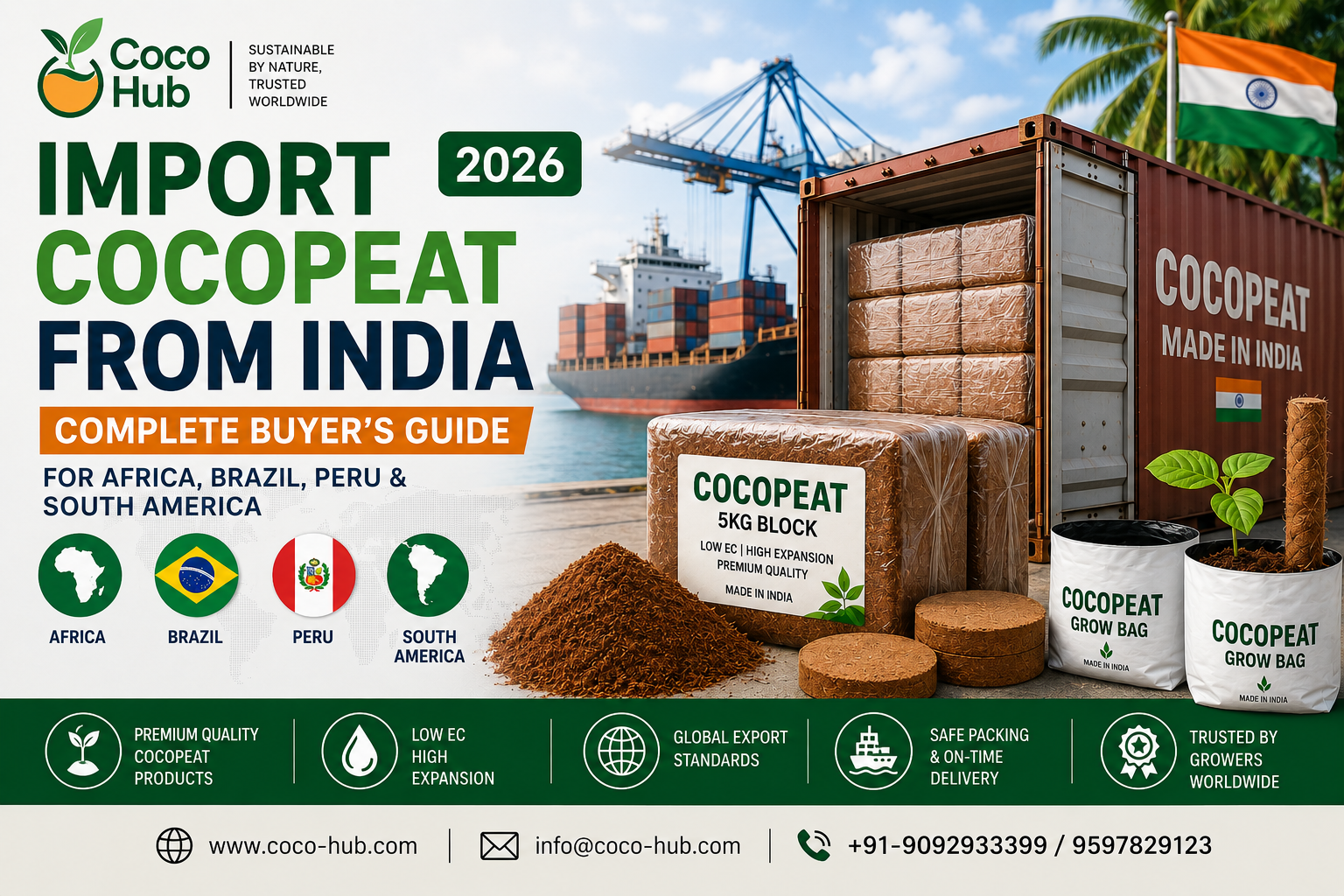
If you’re planning to import cocopeat from India, you’re entering one of the fastest-growing segments of global horticulture and sustainable agriculture.
Across Africa, Brazil, Peru, Colombia, Chile, Ecuador, and other South American markets, growers are rapidly adopting cocopeat as a superior alternative to traditional soil and peat moss. From hydroponic farms and greenhouse operations to commercial nurseries and export-oriented agriculture, cocopeat has become an essential growing medium due to its excellent water retention, aeration, root development support, and sustainability benefits.
India remains the world’s leading producer and exporter of cocopeat products. The country possesses abundant coconut resources, advanced processing facilities, established export infrastructure, and decades of experience supplying international buyers.
However, importing cocopeat successfully involves much more than simply finding the cheapest supplier online. Buyers must evaluate quality parameters, verify exporter credibility, understand shipping documentation, compare product formats, and ensure compliance with local import regulations.
This comprehensive guide explains everything importers need to know before placing an order for cocopeat from India in 2026.
Whether you are a distributor in Brazil, a greenhouse operator in Peru, a hydroponic grower in Colombia, or an agricultural supplier in Kenya, this guide will help you make informed sourcing decisions and avoid common importing mistakes.
Why Import Cocopeat from India in 2026?
India continues to dominate the global cocopeat industry and remains the preferred sourcing destination for buyers worldwide.
India’s Leadership in the Global Cocopeat Industry
India is one of the largest coconut-producing nations in the world. Major coconut-growing regions such as Tamil Nadu, Kerala, Karnataka, and Andhra Pradesh provide a consistent supply of raw materials required for cocopeat production.
Unlike many competing origins, India has invested heavily in:
- Modern washing systems
- EC reduction technology
- Compression machinery
- Quality testing laboratories
- Export packaging facilities
- Container loading infrastructure
These investments allow Indian manufacturers to produce export-grade cocopeat that meets international quality requirements.
Consistent Product Quality
Professional growers require consistency. A greenhouse operation cannot afford variations in EC levels, pH values, expansion ratios, or impurity content.
Reputable Indian manufacturers maintain strict quality controls throughout the production process, ensuring:
- Stable EC levels
- Consistent expansion ratios
- Low impurity percentages
- Uniform moisture content
- Reliable water holding capacity
This consistency is one of the primary reasons why buyers continue to import cocopeat from India year after year.
Sustainability Advantages
Global agriculture is moving toward environmentally responsible growing media.
Traditional peat moss extraction has come under increasing scrutiny due to environmental concerns. As a result, many growers are actively searching for renewable alternatives.
Cocopeat is produced from coconut husks, a renewable agricultural by-product that would otherwise go unused. This makes it one of the most sustainable growing media available today.
For environmentally conscious growers and buyers, importing cocopeat from India supports both crop performance and sustainability goals.
Competitive Pricing and Better Value
While price should never be the sole purchasing factor, Indian cocopeat generally offers one of the best quality-to-cost ratios available in the market.
Buyers benefit from:
- Competitive manufacturing costs
- Efficient container loading
- Strong export infrastructure
- Large-scale production capacity
This combination allows importers to obtain high-quality cocopeat at competitive prices while maintaining reliable supply chains.
Request a Quote
Why Demand for Indian Cocopeat Is Growing Across Africa
Africa’s agricultural sector is undergoing rapid transformation.
Countries such as South Africa, Kenya, Tanzania, Uganda, Ghana, and Nigeria are investing heavily in greenhouse cultivation, hydroponics, nursery production, and export-oriented agriculture.
Water Efficiency Is Becoming Critical
Many African regions face increasing water challenges.
Cocopeat’s exceptional water retention capacity allows growers to maintain adequate moisture levels while reducing irrigation frequency. This can significantly improve water-use efficiency in both greenhouse and open-field applications.
Expansion of Protected Agriculture
Protected cultivation continues to grow across Africa.
Greenhouses require growing media that provide:
- Excellent aeration
- Strong root development
- Consistent moisture retention
- Disease resistance
Cocopeat meets all these requirements, making it one of the most preferred substrates for modern greenhouse operations.
Growing Hydroponic Adoption
Hydroponic farming is gaining popularity throughout Africa.
Low EC cocopeat is particularly valuable in hydroponic systems because it allows growers to maintain precise control over nutrient delivery while minimizing salt-related issues.
For this reason, many African growers specifically seek Low EC cocopeat when importing from India.
Why Brazil Is Emerging as a Major Cocopeat Import Market
Brazil’s agricultural industry is among the largest and most advanced in South America.
The country has witnessed increasing demand for cocopeat due to expanding greenhouse cultivation, commercial horticulture, berry production, and hydroponic farming.
Growing Demand for Sustainable Substrates
Brazilian growers are increasingly adopting sustainable cultivation practices.
Cocopeat offers:
- Renewable sourcing
- Excellent crop performance
- Reduced environmental impact
- Long-term usability
These advantages align well with Brazil’s growing focus on sustainable agricultural production.
Expansion of High-Value Crop Production
Brazil continues to increase production of:
- Strawberries
- Tomatoes
- Bell peppers
- Cucumbers
- Leafy greens
These crops perform exceptionally well in cocopeat-based growing systems.
As a result, more distributors and commercial growers are looking to import cocopeat from India to support expanding production capacity.
Why Peru, Colombia, Chile and Ecuador Are Increasing Cocopeat Imports
Across South America, countries such as Peru, Colombia, Chile, and Ecuador are rapidly modernizing their agricultural sectors. Export-oriented crops, greenhouse cultivation, floriculture, and hydroponic farming have created significant demand for premium growing media.
As growers seek better yields, improved root development, and more sustainable cultivation methods, many businesses are choosing to import cocopeat from India.
Peru’s Expanding Export Agriculture Sector
Peru has become a major exporter of:
- Blueberries
- Avocados
- Grapes
- Asparagus
- Vegetables
Many of these crops require carefully managed growing environments to maximize productivity and export quality.
Cocopeat offers several advantages:
- Excellent root aeration
- Superior water retention
- Consistent crop performance
- Reduced disease pressure
Peruvian growers increasingly use cocopeat in nurseries, propagation systems, and greenhouse operations to achieve more predictable growing results.
Colombia’s Greenhouse and Hydroponic Growth
Colombia continues expanding its greenhouse cultivation and hydroponic farming sectors.
Low EC cocopeat is particularly attractive because it allows growers to:
- Control nutrient programs accurately
- Reduce salt accumulation
- Improve root development
- Enhance crop uniformity
Hydroponic growers frequently prefer cocopeat over traditional soil due to its consistency and ease of management.
Chile’s Protected Agriculture Industry
Chile has established itself as one of South America’s leading agricultural exporters.
Greenhouse vegetable production and high-value crop cultivation continue increasing demand for reliable growing substrates.
Importers seeking to import cocopeat from India often prioritize:
- Stable EC levels
- High expansion ratios
- Consistent particle size
- Low impurity content
These factors directly impact crop performance and profitability.
Ecuador’s Emerging Horticulture Market
Ecuador’s agricultural sector is diversifying rapidly.
Growers are adopting modern cultivation techniques that rely on premium substrates for:
- Seedling production
- Nursery operations
- Greenhouse vegetables
- Ornamental plants
Indian cocopeat provides an economical and effective solution for these applications.
Types of Cocopeat Products Available for Import
One of the advantages of working with an experienced cocopeat exporter from India is access to multiple product formats designed for different agricultural applications.
Understanding the available options helps buyers select the most suitable products for their market.
5kg Cocopeat Blocks
The 5kg cocopeat block is the most widely traded cocopeat product internationally.
It is highly compressed to maximize container loading efficiency while minimizing freight costs.
Typical Applications
- Commercial farming
- Hydroponics
- Greenhouses
- Horticulture
- Nurseries
Advantages
- Excellent compression ratio
- Easy shipping and storage
- High expansion volume
- Cost-effective logistics
A quality 5kg block typically expands to approximately 70-75 liters after hydration.
Because of its efficiency and versatility, this format remains the preferred choice for importers worldwide.
650gm Cocopeat Blocks
650gm cocopeat blocks are smaller compressed units designed primarily for retail markets and home gardening applications.
Common Uses
- Garden centers
- Retail distribution
- E-commerce sales
- Hobby gardening
Benefits
- Easy handling
- Convenient packaging
- Quick hydration
- Consumer-friendly size
Many distributors in Africa and South America import these products for resale through retail channels.
Cocopeat Grow Bags
Grow bags have become extremely popular among commercial growers.
These products contain compressed cocopeat enclosed within UV-stabilized plastic packaging.
Popular Crops
- Tomatoes
- Strawberries
- Bell peppers
- Cucumbers
- Herbs
Types Available
Open Top Grow Bags
Open Top Grow Bags are pre-cut and ready for planting.
They are widely used in greenhouse cultivation.
Horizontal Grow Bags
Horizontal Grow Bags provide efficient root zone management and are particularly popular among commercial vegetable producers.
Cocopeat Cubes
Cocopeat cubes are designed for seedling propagation and transplant production.
Advantages
- Excellent root development
- Uniform moisture distribution
- Easy transplanting
- Consistent growth
Many greenhouse operators use cocopeat cubes to improve propagation success rates.
Cocopeat Discs and Coins
Cocopeat discs and coins are compressed growing media products designed for nurseries and seed starting applications.
When hydrated, they expand into ready-to-use growing plugs.
Benefits
- Easy storage
- Simple transportation
- Consistent expansion
- Excellent germination performance
These products are increasingly popular in commercial nursery operations.
Cocopeat Chip Blocks
Cocopeat chip blocks combine coir pith with coconut husk chips.
This mixture provides enhanced aeration and drainage characteristics.
Ideal Applications
- Orchids
- Anthuriums
- Tropical plants
- Specialized horticulture
Growers who require additional root aeration often prefer chip-based substrates.
Coco Poles
Coco poles are widely used as climbing supports for:
- Monstera
- Pothos
- Philodendron
- Money plants
- Decorative climbers
Manufactured using natural coconut fiber, coco poles encourage healthy aerial root development.
Coir Pots
Coir pots are biodegradable planting containers made from coconut fiber.
Benefits include:
- Sustainable cultivation
- Reduced transplant shock
- Improved root penetration
- Environmentally friendly disposal
As sustainability becomes increasingly important, demand for coir pots continues to rise.
Quality Parameters to Verify Before You Import Cocopeat from India
One of the biggest mistakes new importers make is focusing solely on price.
Professional buyers understand that product quality directly influences crop performance.
Before placing an order, every importer should evaluate the following quality parameters.
Electrical Conductivity (EC)
Electrical Conductivity measures soluble salt concentration within cocopeat.
It is one of the most important indicators of substrate quality.
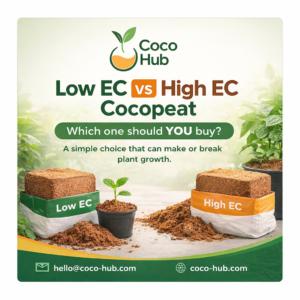
Low EC Cocopeat
Low EC cocopeat generally ranges between:
0.2 mS/cm to 0.8 mS/cm
This category is preferred for:
- Hydroponics
- Greenhouses
- High-value crops
- Controlled fertigation systems
High EC Cocopeat
High EC cocopeat contains elevated salt levels and may require additional washing before use.
Always request laboratory reports confirming EC levels before purchasing.
pH Level
The pH level affects nutrient availability and root health.
Most crops perform best when grown in cocopeat with a pH range between:
5.5 and 6.8
Reliable exporters regularly test and monitor pH during production.
Expansion Ratio
Expansion ratio determines how much usable growing media is obtained after hydration.
A premium-quality cocopeat block should:
- Expand uniformly
- Produce consistent volume
- Maintain fluffy structure
- Avoid excessive compaction
Expansion testing is a standard quality verification procedure among professional buyers.
Water Holding Capacity
Water retention is one of cocopeat’s greatest advantages.
High-quality cocopeat should:
- Retain moisture effectively
- Maintain adequate aeration
- Support root development
- Prevent waterlogging
Balancing water retention and air porosity is critical for crop success.
Impurity Content
Impurities negatively affect substrate performance.
Potential contaminants include:
- Sand
- Stones
- Plastic fragments
- Excessive fiber
- Foreign materials
Premium export-grade cocopeat generally contains less than 3% impurities.
Many professional importers conduct impurity testing before approving shipments.
Compression Ratio
Proper compression directly affects shipping economics.
Higher compression allows:
- Greater container utilization
- Lower freight costs
- Improved storage efficiency
Professional exporters optimize compression without compromising expansion performance.
Moisture Content
Moisture levels must remain within acceptable ranges to maintain product quality during storage and transport.
Excess moisture can create handling issues and affect product consistency.
Reliable exporters monitor moisture levels throughout production and packaging.
How to Verify a Cocopeat Exporter from India: The 6-Step Buyer Verification Process
Choosing the right supplier is arguably the most important decision you’ll make when you import cocopeat from India.
While India is home to hundreds of cocopeat suppliers, not all exporters maintain the same quality standards, production capabilities, or export expertise.
A supplier may offer an attractive price, but if they fail to meet quality specifications, shipping schedules, or documentation requirements, the resulting losses can far exceed any initial savings.
The following six-step verification process can help buyers reduce risk and identify reliable long-term suppliers.
Step 1: Verify Manufacturing Capability
Many companies market themselves as manufacturers while operating purely as trading businesses.
Before placing an order, determine whether the supplier:
- Owns a manufacturing facility
- Controls production processes
- Conducts in-house quality testing
- Maintains inventory capacity
Request:
- Factory photographs
- Production videos
- Manufacturing process documentation
- Facility certifications
A genuine manufacturer can typically provide these materials without hesitation.
Step 2: Evaluate Export Experience
Exporting agricultural products requires significant expertise.
Ask suppliers:
- Which countries do you currently export to?
- How many containers do you ship annually?
- What percentage of your business is export-focused?
- How long have you been exporting?
Exporters with established international experience are generally better equipped to manage documentation, compliance, logistics, and communication.
Step 3: Request Quality Test Reports
Professional cocopeat exporters should provide documented quality reports.
Key parameters include:
EC Test Results
Confirms salt concentration levels.
pH Analysis
Verifies substrate suitability for cultivation.
Expansion Test Results
Demonstrates expected hydration performance.
Moisture Analysis
Ensures shipping suitability.
Impurity Analysis
Confirms compliance with quality standards.
Never rely solely on verbal claims.
Request actual laboratory data whenever possible.
Step 4: Request Product Testing Videos
Modern buyers increasingly request visual proof of quality.
Useful videos include:
- EC testing demonstrations
- Expansion tests
- Volume tests
- Manufacturing process videos
- Container loading procedures
Video evidence provides additional confidence and transparency.
Step 5: Verify References
Established exporters often maintain long-term customer relationships.
Ask whether references are available from:
- Importers
- Distributors
- Greenhouse operators
- Commercial growers
While not all customers will agree to provide references, experienced exporters generally have a verifiable export history.
Step 6: Start with Samples
Even when working with highly reputable exporters, sample evaluation remains essential.
Before committing to a full container order:
- Test expansion performance
- Conduct EC testing
- Measure pH
- Evaluate impurities
- Perform crop trials
A small investment in testing can prevent costly mistakes later.
Export Documents Required to Import Cocopeat from India
One of the advantages of working with experienced exporters is proper documentation support.
Although import requirements vary by country, most shipments require the following documents.
Commercial Invoice
The commercial invoice contains:
- Buyer information
- Seller information
- Product details
- Quantity
- Unit pricing
- Shipment value
Customs authorities use this document to assess import duties and taxes.
Packing List
The packing list provides:
- Packaging details
- Pallet information
- Net weight
- Gross weight
- Container loading information
This document assists customs inspections and inventory verification.
Bill of Lading
The Bill of Lading serves as the primary shipping document.
It confirms:
- Cargo ownership
- Shipment details
- Port information
- Carrier details
Without this document, cargo release becomes difficult.
Certificate of Origin
Many countries require a Certificate of Origin.
This document confirms that the products were manufactured in India.
In some cases, it may help buyers obtain preferential tariff treatment.
Phytosanitary Certificate
Since cocopeat is an agricultural product, importing countries frequently require a phytosanitary certificate.
This document confirms:
- Compliance with plant health regulations
- Freedom from harmful pests
- Export suitability
Always confirm specific requirements with local authorities.
Fumigation Certificate
Some destinations require fumigation documentation depending on local import regulations.
Requirements vary significantly by country.
Insurance Documentation
Marine cargo insurance protects buyers against losses resulting from:
- Container damage
- Water ingress
- Theft
- Transit-related incidents
While optional in some cases, insurance is strongly recommended.
What to Expect Per Container in 2026
Container optimization significantly affects landed costs.
Understanding typical loading capacities helps buyers compare quotations more effectively.
40-Foot Container Loading Capacity
A standard 40-foot container remains the preferred shipping option for cocopeat exports.
Typical capacities include:
5kg Cocopeat Blocks
Approximately:
- 22 to 26 metric tons
- Depending on compression and packaging
650gm Cocopeat Blocks
Significantly higher quantities due to smaller unit size.
Grow Bags
Loading capacity depends on:
- Bag dimensions
- Packaging configuration
- Compression levels
Cocopeat Discs and Coins
Can often achieve extremely efficient container utilization due to compact packaging.
Always request detailed container loading plans before confirming orders.
Common Mistakes When You Import Cocopeat from India
Many importing challenges are entirely avoidable.
Understanding common sourcing mistakes can save considerable time and money.
Choosing the Cheapest Supplier
Price alone should never determine supplier selection.
Extremely low prices often indicate:
- Inconsistent quality
- Higher impurity levels
- Poor washing processes
- Reduced expansion performance
A slightly higher-priced supplier may provide significantly better long-term value.
Ignoring EC Levels
Many buyers focus on appearance while overlooking EC.
Unfortunately, excessive salt levels can create serious cultivation problems.
Always request EC reports before purchasing.
Not Conducting Sample Tests
Sample testing remains one of the most effective risk-reduction strategies available.
Skipping this step can result in:
- Crop issues
- Customer complaints
- Product rejection
- Financial losses
Overlooking Documentation Requirements
Import regulations vary widely between countries.
Failure to prepare proper documentation can result in:
- Customs delays
- Storage charges
- Shipment rejection
Always verify requirements before shipment.
Working with Inexperienced Exporters
Exporting involves much more than manufacturing.
Documentation, compliance, logistics coordination, and communication all play important roles.
Experienced exporters typically provide smoother transactions and better customer support.
Why More Global Buyers Are Choosing Coco-Hub
As international demand for premium growing media continues to increase, buyers are looking for suppliers capable of delivering consistency, transparency, and reliable export support.
Coco-Hub focuses on supplying high-quality coconut coir products to customers worldwide.
Our product portfolio includes:
- 5kg Cocopeat Blocks
- 650gm Cocopeat Blocks
- Cocopeat Chip Blocks
- Grow Bags
- Cocopeat Cubes
- Cocopeat Discs & Coins
- Coco Poles
- Coir Pots
- Coir Fiber Bundles
- Twisted Coir Ropes
We prioritize:
- Quality verification
- Export-grade production
- Consistent supply
- Transparent communication
- Customer-focused service
Our objective is to help importers build long-term, dependable sourcing relationships.
Learn more about our 5kg Cocopeat Blocks.
Explore our Grow Bags for greenhouse cultivation.
View our Cocopeat Chip Blocks for orchids and tropical crops.
Browse our Coir Pots and nursery solutions.
Contact our team through our Contact Page.
Why Businesses Continue to Import Cocopeat from India
Businesses continue to import cocopeat from India because of the country’s strong manufacturing infrastructure, abundant coconut resources, and extensive export experience. Companies that import cocopeat from India benefit from reliable supply chains, competitive pricing, and access to a wide range of coconut coir products suitable for agriculture, horticulture, hydroponics, and greenhouse cultivation.
Frequently Asked Questions
Is Indian cocopeat better than peat moss?
Many growers prefer cocopeat because it is renewable, sustainable, and offers excellent water retention and aeration.
What is Low EC cocopeat?
Low EC cocopeat contains lower salt levels and is generally preferred for hydroponics, greenhouses, and sensitive crops.
How many liters does a 5kg cocopeat block produce?
Most quality blocks expand to approximately 70-75 liters after hydration.
What pH should cocopeat have?
Generally between 5.5 and 6.8 for optimal crop performance.
What impurity level is acceptable?
Premium export-grade cocopeat typically contains less than 3% impurities.
Which countries import the most cocopeat from India?
Major markets include:
- Netherlands
- Spain
- Germany
- Brazil
- Peru
- Chile
- South Africa
- Kenya
Is cocopeat suitable for hydroponics?
Yes. Low EC cocopeat is widely used in hydroponic systems worldwide.
Can cocopeat be reused?
Yes. With proper treatment and management, cocopeat can often be reused for multiple growing cycles.
What shipping documents are required?
Most shipments require:
- Commercial Invoice
- Packing List
- Bill of Lading
- Certificate of Origin
- Phytosanitary Certificate
How can I verify a cocopeat supplier?
Request:
- Quality reports
- Production videos
- Export references
- Samples
- Documentation records
before placing large orders.
Conclusion
If you are planning to import cocopeat from India in 2026, selecting the right exporter is one of the most important decisions you will make.
For growers, distributors, and agricultural businesses seeking reliable growing media, the decision to import cocopeat from India remains one of the most cost-effective and sustainable sourcing choices available in 2026.
India’s extensive coconut resources, advanced manufacturing infrastructure, export expertise, and ability to supply consistent quality products have positioned the country as the preferred source for cocopeat worldwide.
Whether you are sourcing for greenhouse cultivation in Brazil, hydroponic farming in Peru, commercial agriculture in Colombia, floriculture in Ecuador, or protected cultivation projects across Africa, understanding quality parameters, supplier verification procedures, and import requirements will help ensure long-term success.
By focusing on Low EC cocopeat, expansion performance, impurity control, proper documentation, and supplier transparency, buyers can establish dependable supply chains that support productivity, profitability, and sustainable growth.
For businesses looking to source premium coconut coir products directly from India, careful supplier evaluation and quality verification remain the foundation of every successful import program.
According to the Food and Agriculture Organization (FAO), sustainable growing media continue to play a critical role in modern agriculture.
International trade data from the International Trade Centre (ITC) highlights the increasing global demand for coconut coir products.



Add comment