
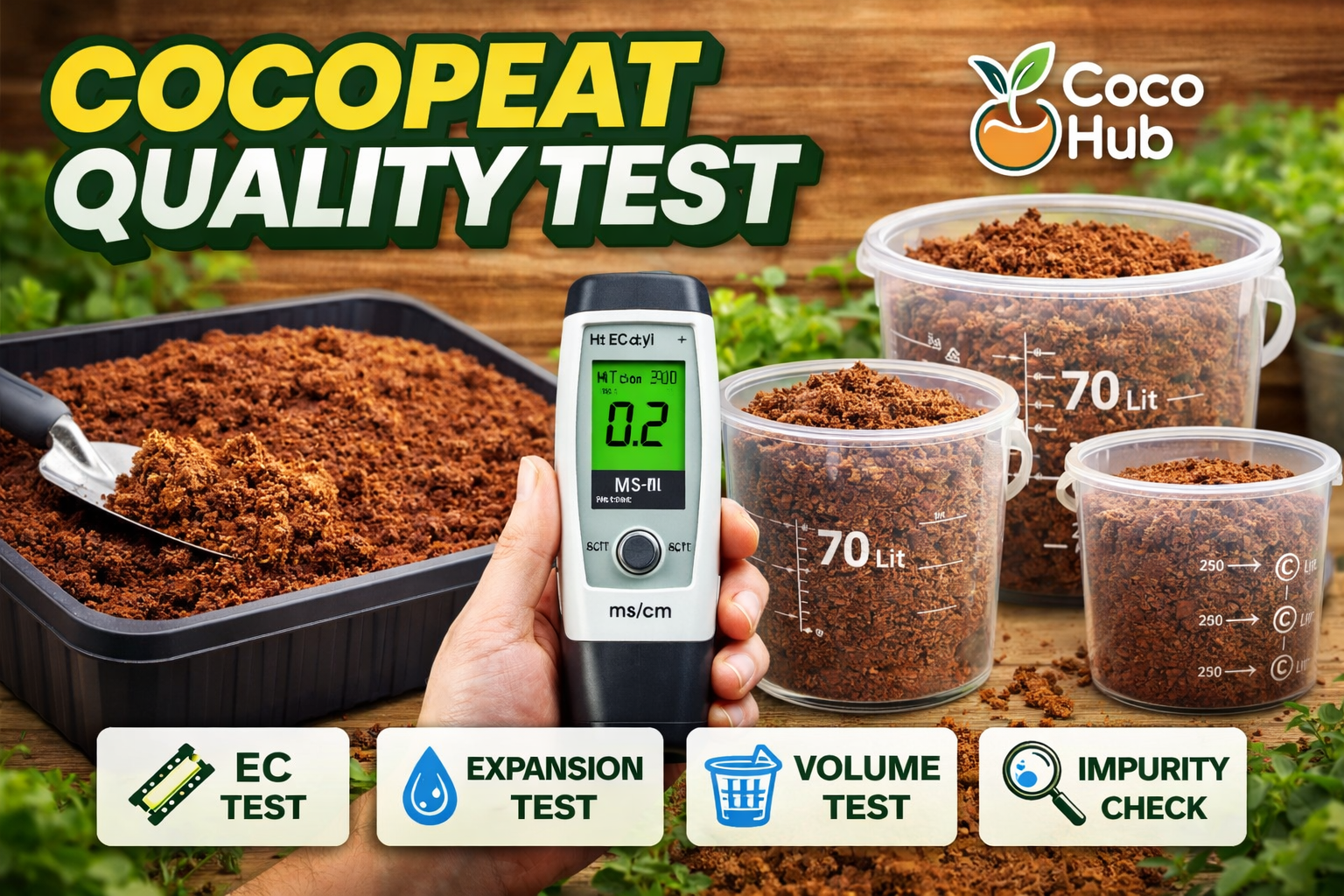
Cocopeat quality test is one of the most important steps when selecting cocopeat blocks for agriculture, hydroponics, and commercial farming. A proper cocopeat quality test ensures the growing media meets agricultural standards and supports healthy plant growth.
High-quality cocopeat provides excellent water retention, root aeration, and nutrient absorption. However, not all cocopeat blocks available in the market meet the same quality standards. Poorly processed cocopeat can contain excessive salts, impurities, and inconsistent texture that negatively impact plant health.
For growers, greenhouse operators, and cocopeat importers, performing a cocopeat quality test before using the product is essential. These tests help determine whether the cocopeat is suitable for sensitive crops, hydroponic systems, or large-scale agricultural production.
In this guide, we will explain four essential cocopeat quality tests used by professional growers and cocopeat buyers worldwide.
These include:
• Cocopeat EC Test
• Cocopeat Expansion Test
• Cocopeat Volume Test
• Cocopeat Impurity Test
By understanding these tests, buyers can confidently choose cocopeat from reliable cocopeat suppliers and manufacturers.
Why Cocopeat Quality Testing is Important
Before exporting cocopeat blocks to international markets, manufacturers must ensure consistent quality standards. Performing a cocopeat quality test allows growers and importers to verify that the cocopeat meets industry requirements.
Cocopeat is produced from coconut husks through several processing stages including:
• Washing
• Drying
• Sieving
• Buffering
• Compression
The final product is typically exported as compressed cocopeat blocks to reduce shipping costs.
However, if the manufacturing process is poorly managed, the cocopeat may contain several quality issues such as:
• High salt concentration
• Sand or dust contamination
• Excess coconut fibers
• Poor expansion capacity
• Uneven particle size
These problems can directly affect plant growth and crop productivity.
For example:
High EC cocopeat can burn plant roots.
Low expansion cocopeat reduces oxygen availability.
Impurities can clog irrigation systems.
This is why commercial growers perform a cocopeat quality test before using the growing medium.
Cocopeat Quality Test #1: EC Test (Electrical Conductivity)
The EC test is the most important cocopeat quality test performed by growers and cocopeat buyers.
EC stands for Electrical Conductivity, which measures the salt concentration present in cocopeat. High salt levels can negatively affect plant growth, especially in hydroponic farming systems.
Why EC Matters in Cocopeat
Coconut husks naturally contain salts such as:
• Sodium
• Potassium
• Chloride
During manufacturing, cocopeat must be washed thoroughly to remove excess salts. If the washing process is inadequate, the cocopeat may have a high EC value.
High EC cocopeat can cause:
• Nutrient imbalance
• Root burn
• Poor seed germination
• Reduced plant growth
For hydroponic systems and greenhouse farming, low EC cocopeat is essential.
How to Perform a Cocopeat EC Test
Performing a cocopeat EC test is simple and requires only a basic EC meter.
Step-by-step process:
- Take a sample of cocopeat from the block.
- Mix the sample with distilled water.
- Stir the mixture and allow it to settle.
- Insert the EC meter into the solution.
- Record the EC reading.
Ideal EC Values for Cocopeat
Typical industry standards:
• Low EC cocopeat: less than 0.5 mS/cm
• Buffered cocopeat: 0.5 – 1.0 mS/cm
• High EC cocopeat: greater than 1.0 mS/cm
Professional hydroponic growers prefer low EC cocopeat because it prevents salt stress on plant roots.
According to agricultural research on growing media standards, salt levels must be carefully controlled to ensure plant health.
https://www.fao.org
Cocopeat Quality Test #2: Expansion Test
The cocopeat expansion test checks how well a compressed cocopeat block expands when water is added.
Because cocopeat is compressed for shipping, proper expansion is critical for creating a suitable growing medium.
A successful cocopeat quality test should show that the block expands into soft, fluffy material.
Why Expansion Matters
Good cocopeat expansion ensures:
• Proper root development
• Improved oxygen circulation
• High water retention capacity
• Balanced nutrient absorption
If a cocopeat block fails the expansion test, it may indicate poor processing or over-compression.
How to Perform the Cocopeat Expansion Test
Step-by-step method:
- Place the cocopeat block inside a container.
- Slowly add water to hydrate the block.
- Allow the block to absorb the water completely.
- Observe the expansion process.
- Check the texture of the expanded cocopeat.
High-quality cocopeat should become loose, soft, and uniform.
Cocopeat Quality Test #3: Volume Test
The cocopeat volume test measures how much growing media is produced after hydration.
This test is extremely important for importers because cocopeat blocks are sold by weight but used by volume.
Performing this cocopeat quality test ensures buyers receive the expected quantity of growing media.
Why Volume Matters
If a cocopeat block produces less volume than expected, growers receive less usable material.
This can result in:
• Increased production costs
• Reduced planting capacity
• Lower overall value
How to Perform the Cocopeat Volume Test
Step-by-step process:
- Hydrate the compressed cocopeat block.
- Break apart the expanded material.
- Place the cocopeat into a measuring container.
- Record the final volume.
Industry Expansion Standards
Typical volume standards include:
5 kg cocopeat block → 70–75 liters
650 g cocopeat brick → 8–9 liters
25 kg cocopeat bale → 300–320 liters
Manufacturers performing a reliable cocopeat quality test ensure consistent expansion ratios.
Cocopeat Quality Test #4: Impurity Test
Another important cocopeat quality test is the impurity inspection.
High-quality cocopeat should be clean and free from unwanted particles.
Common Cocopeat Impurities
Poorly processed cocopeat may contain:
• Sand particles
• Small stones
• Coconut shell pieces
• Excess fibers
• Dust contamination
These impurities can affect root growth and irrigation systems.
Hydroponic systems are especially sensitive to impurities in growing media.
https://www.hydroponics.com
Acceptable Industry Standard
Professional cocopeat manufacturers maintain impurity levels below:
Less than 3% impurities
A proper cocopeat quality test ensures the growing media remains suitable for commercial agriculture and hydroponic farming.
Cocopeat Products Used in Modern Agriculture
Cocopeat products are widely used in greenhouse farming, nurseries, hydroponic systems, and horticulture.
At Coco-Hub, we supply several coconut coir products designed for agricultural and commercial use.
Cocopeat Blocks
Compressed cocopeat blocks are the most widely used growing medium.
They are commonly used in:
• Greenhouses
• Hydroponic farms
• Nurseries
• Vegetable cultivation
Learn more about cocopeat products:
https://coco-hub.com
Cocopeat Chip Blocks
Cocopeat chip blocks contain a mix of cocopeat and coconut husk chips.
Benefits include:
• Better aeration
• Improved drainage
• Suitable for orchids and specialty crops
Grow Bags
Grow bags are widely used in commercial hydroponic farming systems.
They provide:
• Controlled root environment
• Efficient irrigation
• Easy crop management
Coir Pots
Coir pots are biodegradable planting containers made from coconut fiber.
They are ideal for:
• Nursery plants
• Seedlings
• Organic farming
Coir Fiber Bundles
Coir fiber bundles are used in industries such as:
• Mattress production
• Landscaping
• Soil erosion control
Twisted Coir Ropes
Twisted coir ropes are durable and biodegradable products used in:
• Agriculture
• Landscaping
• Construction support
Watch the Cocopeat Quality Test Video
In the following video, we demonstrate how to perform a cocopeat quality test using four essential methods.
The video explains:
• Cocopeat EC test
• Cocopeat expansion test
• Cocopeat volume test
• Cocopeat impurity test
Why Choose Coco-Hub as Your Cocopeat Supplier
Coco-Hub is a trusted cocopeat manufacturer and exporter supplying high-quality coconut coir products to international markets.
Our quality control process includes strict cocopeat quality testing to ensure every batch meets global agricultural standards.
Our product range includes:
• Cocopeat blocks
• Cocopeat chip blocks
• Grow bags
• Coir pots
• Coir fiber bundles
• Twisted coir ropes
Final Thoughts
Performing a cocopeat quality test is essential for growers, nurseries, hydroponic farms, and agricultural importers.
By conducting tests such as:
• Cocopeat EC test
• Cocopeat expansion test
• Cocopeat volume test
• Cocopeat impurity test
buyers can easily identify high-quality cocopeat blocks suitable for agriculture.
As sustainable agriculture continues to grow globally, cocopeat remains one of the most reliable and eco-friendly growing media available.
📧 Export inquiries
[email protected]
🌍 Website
https://coco-hub.com



Add comment